



By Khurram Malik, Senior Director of Product Marketing, Marvell
As AI, cloud computing, and high-performance workloads continue to grow rapidly, data centers are accelerating their infrastructure upgrades. Central to this transformation is the migration to DDR5 memory, designed to meet the increasing demands for bandwidth and speed in servers.
This shift, however, comes with a significant challenge: millions of fully functional DDR4 memory modules, the dominant memory inside today’s servers, could be retired prematurely. This is not because of a performance failure. DDR4 memory modules can operate for a decade or longer. Instead, it is because the latest generation of server CPUs only support DDR5 memory. Put another way, when hyperscalers replace their current servers with DDR5 modules over the coming years, they will be potentially throwing away billions of GBs of fully functional DDR4 memory if they can’t find ways to use them.
The result is a looming e-waste problem and an environmental impact that cannot be ignored. Up to 66 billion kilograms of CO₂ emissions—approximately the same amount that would be generated by 168 billion miles of driving1-- and thousands of tons of e-waste can be avoided by giving DDR4 a second life. Marvell® CXL Structera™ X presents a powerful solution by extending the life of DDR4 memory, enabling data centers to reuse these existing assets, reduce capital expenditures, and minimize their carbon footprint—all while improving the performance footprint of their infrastructure.
Marvell CXL Structera X: A Pathway for More Memory
Released last year, Marvell Structera CXL devices effectively allow cloud operators and system designers to add extra memory, memory bandwidth, and/or computing cores to servers by transforming an open PCIe interface into a memory channel. A first-of-its kind device, the Structera A memory accelerator provides a path for adding up to 16 server CPU cores, 200Gb of memory bandwidth and 4TB of memory for offloading the processing of deep learning recommendation models (DLRM) and other tasks for CPUs.
Structera X, meanwhile, focuses on maximizing capacity. A single Structera X 2404 is capable of supporting up to 12 DDR4 additional DIMMs, or 6TB memory capacity without compression, or up to 12TB with LZ4 inline compression in a single one- or two-processor server. It is also the first CXL device to be compatible with both DDR4 or DDR5. As a result, Structera X becomes a conduit for recycling DDR4. The diagram shows more:
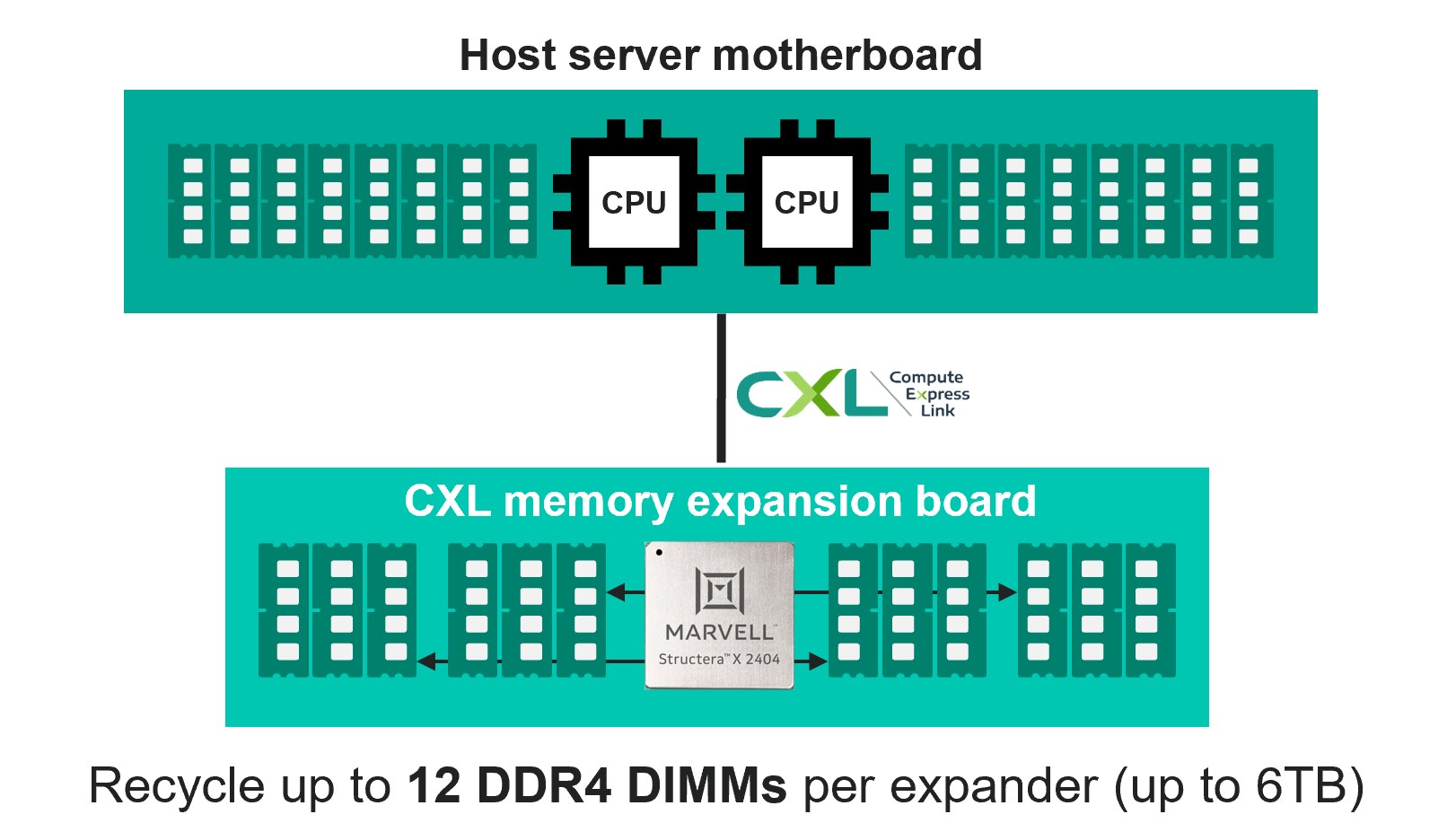
Financially, reusing memory is a boon. July 2025 spot prices for 96GB DIMMs of DDR5 memory range from $458 to $488.2 Repurposing TBs of otherwise-to-be-discarded DDR4 instead of buying new DDR5 means thousands of dollars saved per CXL-enhanced server.
By Michael Kanellos, Head of Influencer Relations, Marvell
The opportunity for custom silicon isn’t just getting larger – it’s becoming more diverse.
At the Custom AI Investor Event, Marvell executives outlined how the push to advance accelerated infrastructure is driving surging demand for custom silicon – reshaping the customer base, product categories and underlying technologies. (Here is a link to the recording and presentation slides.)
Data infrastructure spending is now slated to surpass $1 trillion by 20281 with the Marvell total addressable market (TAM) for data center semiconductors rising to $94 billion by then, 26% larger than the year before. Of that total, $55.4 billion revolves around custom devices for accelerated compute1. In fact, the forecast for every major product segment has risen in the past year, underscoring the growing momentum behind custom silicon.
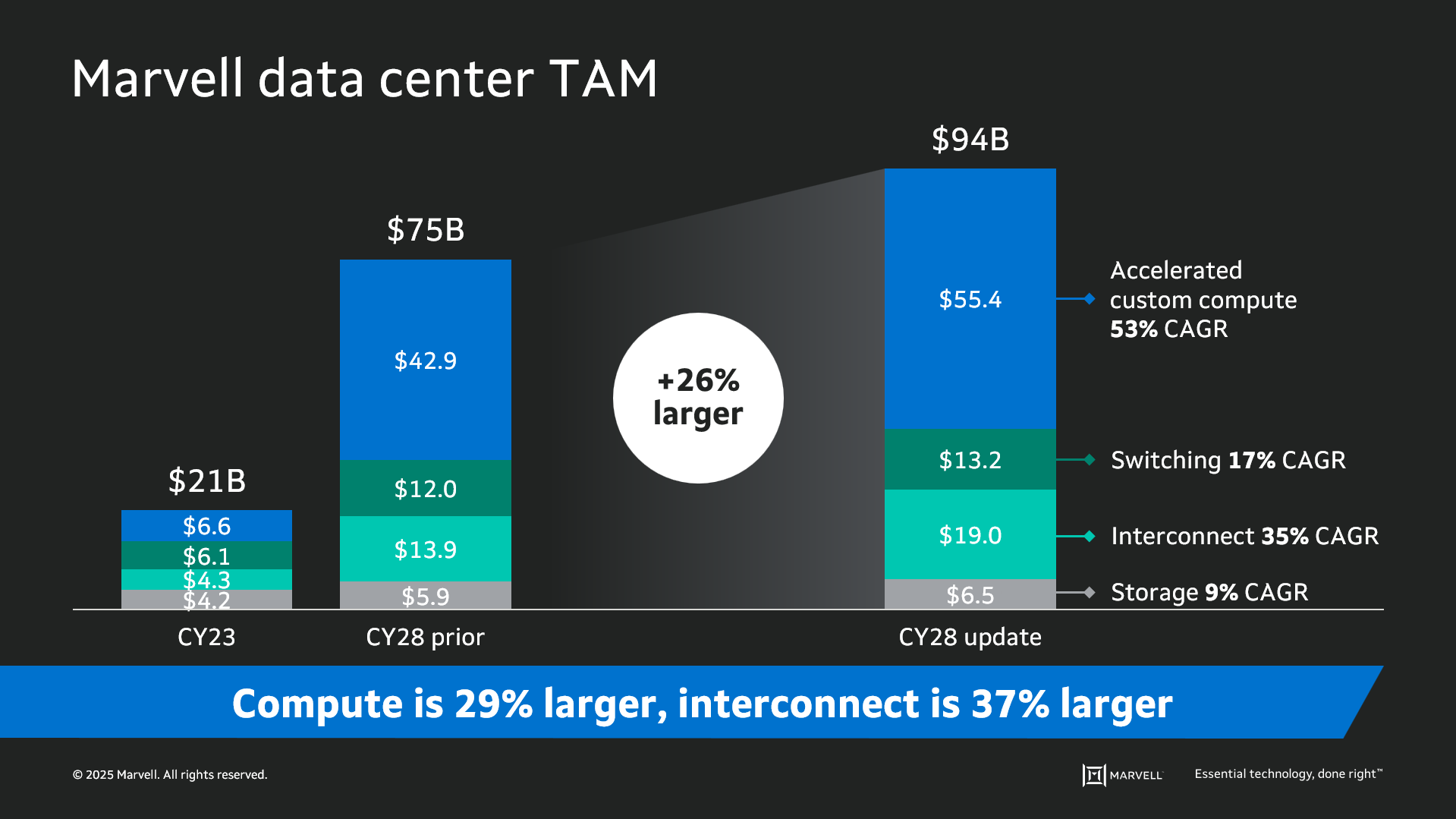
The deeper you go into the numbers, the more compelling the story becomes. The custom market is evolving into two distinct elements: the XPU segment, focused on optimized CPUs and accelerators, and the XPU attach segment that includes PCIe retimers, co-processors, CPO components, CXL controllers and other devices that serve to increase the utilization and performance of the entire system. Meanwhile, the TAM for custom XPUs is expected to reach $40.8 billion by 2028, growing at a 47% CAGR1.
By Kirt Zimmer, Head of Social Media Marketing, Marvell
The OFC 2025 event in San Francisco was so vast that it would be easy to miss a few stellar demos from your favorite optical networking companies. That’s why we took the time to create videos featuring the latest Marvell technology.
Put them all together and you have a wonderful film festival for technophiles. Enjoy!
We spoke with Kishore Atreya, Senior Director of Cloud Platform Marketing at Marvell, who discussed co-packaged optics. Instead of moving data via electrons, a light engine converts electrical signals into photons—unlocking ultra-high-speed, low-power optical data transfer.
The 1.6T and 6.4T light engines from Marvell can be integrated directly into the chip package, minimizing trace lengths, reducing power and enabling true plug-and-play fiber connectivity. It is flexible, scalable, and built for switching, XPUs, and beyond.
By Doug Watanabe, Senior Manager Communications, Marvell

Marvell has been honored with a place on the Forbes list of America’s Best Employers for New Grads 2025. This prestigious recognition highlights the company’s commitment to fostering a workplace where recent graduates can grow, thrive, and make a meaningful impact from day one. The 2025 list celebrates companies that provide outstanding experiences for early-career professionals.
“I’m incredibly proud that Marvell has been recognized by Forbes as one of America’s Best Employers for New Grads,” said Tara Hsu, Global Head of Talent, Attraction, Mobility and Inclusion, at Marvell. “As we continue to build the talent and skills essential to the semiconductor industry, we’re launching a comprehensive New Grad Onboarding Program to support early-career professionals through their first and second years at Marvell—setting them off on the right foot with the technical depth, industry exposure, and leadership development they need to thrive.”
“We’re equally proud of our global internship program, which will welcome 360 interns in 2025, and we’re expanding our reach even further with the launch of a Sophomore Program to engage emerging talent earlier in their journey,” continued Hsu. “These investments reflect our commitment to developing the next generation of semiconductor innovators.”
By Nizar Rida, Vice President of Engineering and Country Manager, Marvell Canada
This blog first appeared in The Future Economy
AI has the potential to transform the way we live. But for AI to become sustainable and pervasive, we also have to transform our computing infrastructure.
The world’s existing technologies, simply put, weren’t designed for the data-intensive, highly parallel computing problems that AI serves up. As a result, AI clusters and data centers aren’t nearly as efficient or elegant as they could be: in many ways, it’s brute force computing. Power1 and water2 consumption in data centers are growing dramatically and many communities around the world are pushing back on plans to expand data infrastructure.3
Canada can and will play a leading role in overcoming these hurdles. Data center expansion is already underway. Data centers currently account for around 1GW, or 1%, of Canada’s electricity capacity. If all of the projects in review today get approved, that total could grow to 15GW, or enough to power 70% of the homes in the country.4
Like in other regions, data center operators are exploring ways to increase their use of renewables and nuclear in these new facilities along with ambient cooling to reduce their carbon footprint of their facilities. In Alberta, some companies are also exploring adding carbon capture to the design of data centers powered by natural gas. To date, carbon capture has not lived up to its promise.5 Most carbon capture experiments, however, have been coupled with large-scale industrial plants. It may be worth examining if carbon capture—combined with mineralization for long-term storage—can work on this smaller scale. If it does, the technology could be exported to other regions.
Fixing facilities, however, is only part of the equation. AI requires a fundamental overhaul in the systems and components that make up our networks.
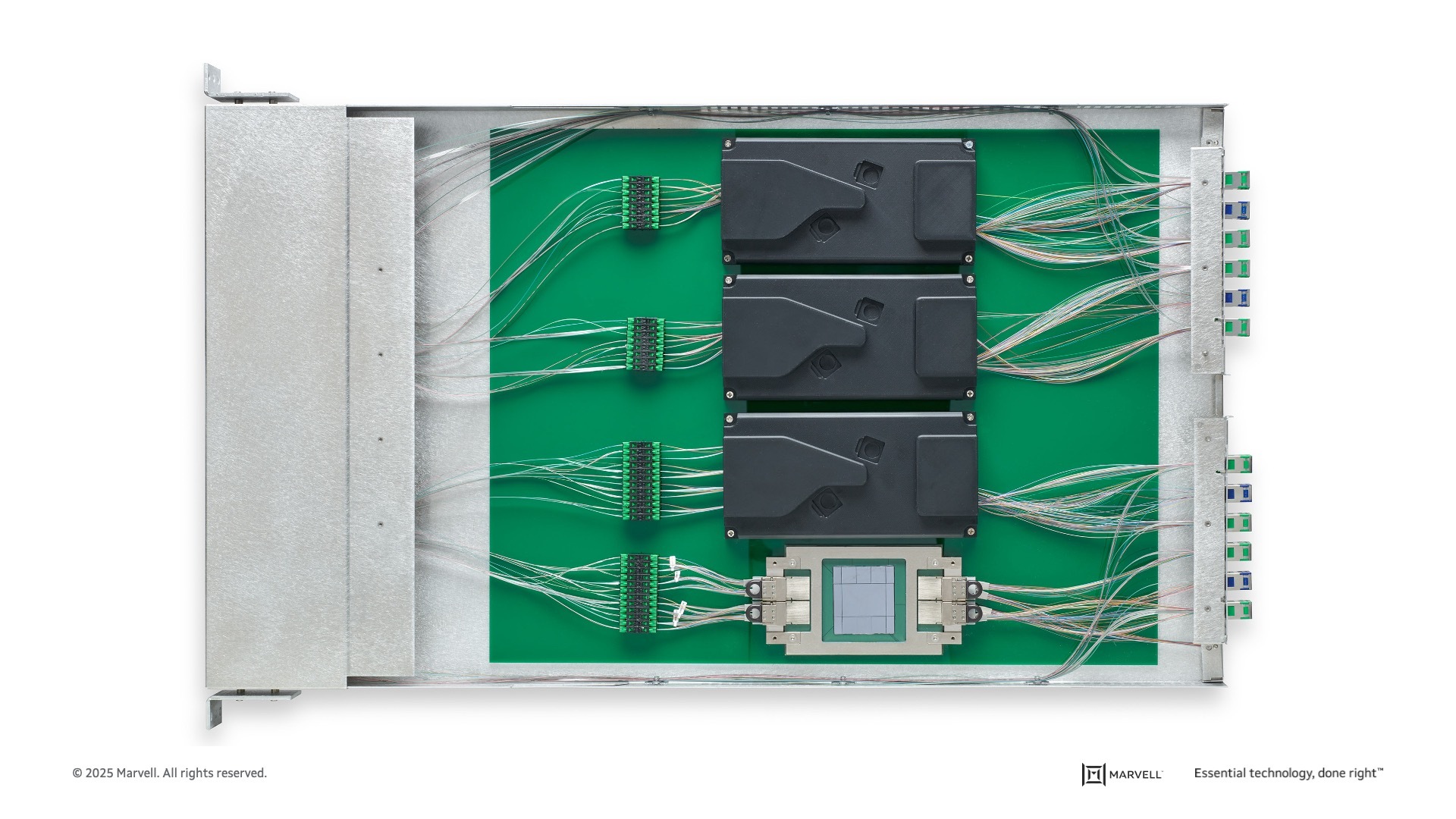
Above: The server of the future. The four AI processors connect to networks through four 6.4T light engines, the four smaller chips on the east-west side of the exposed processor. Coupling optical technology with the processor lowers power per bit while increasing bandwidth.